Intelligent Agents: A Practical Approach to Getting Started

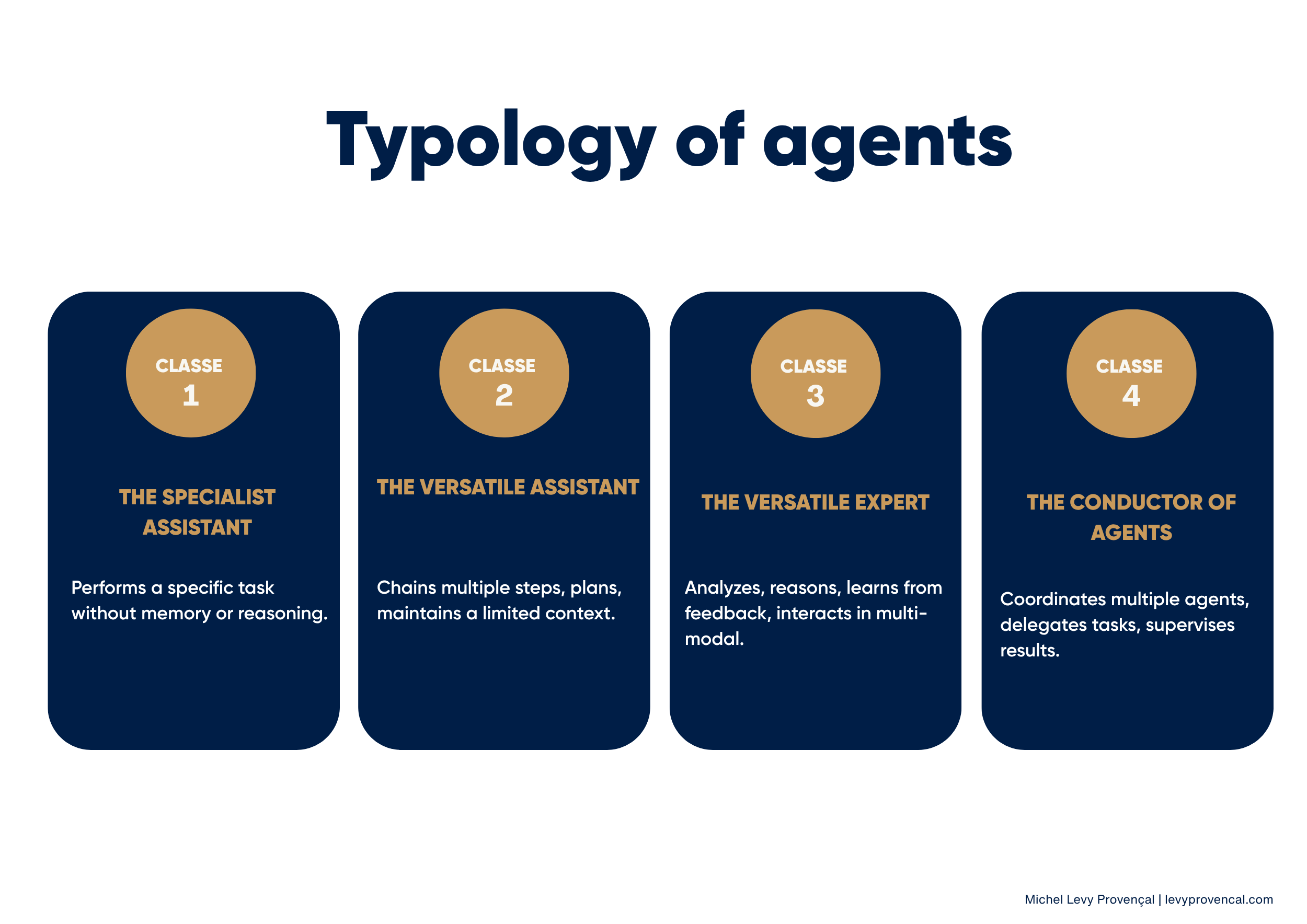
Over the past few weeks, I’ve shared insights on how organizations are using generative AI to boost productivity. Today, we’re entering a new phase: the rise of AI agents (software entities capable of acting, planning, and sometimes delegating).
Before we dive into the different types of agents, let’s quickly revisit the key stages of AI adoption in organizations:
AI Maturity Levels
Maturity Level Description
1 – Controlled AI Use Teams use tools like ChatGPT, Gemini, or Copilot Pro with no access to company data. Individual productivity gains are noticeable.
2 – Contextual AI with Business Data AI taps into internal data to provide actionable answers. Example: an HR bot handling employee queries.
3 – Automation via Agents Specialized agents run micro-processes like follow-ups, content generation, or report consolidation.
4 – Symbiotic Organization Multiple agents interact and collaborate. Humans oversee exceptions and strategy. In level 4+, agents manage other agents.
In France, only 20–25% of companies have reached level 1. Most are still at level 0 shadow AI, where employees use free AI tools unofficially, often exposing the organization to significant risks.
But things are changing fast. Over the coming months, adoption will accelerate until we hit a critical threshold: the leap from level 3 (a few isolated agents) to level 4 (an interconnected ecosystem of agents).
Why the Leap from 3 → 4 Changes Everything
At Level 3: Each team builds its own agent in isolation. This is fairly easy (think GPTs configured to execute specific tasks based on internal data). You can do this with natural language and strong prompting.
At Level 4: You’re managing a colony of interoperable agents that share memory and have defined roles. This demands technical expertise and tooling that is still maturing.
How to Make the Leap
Step Action Map your processes Identify already-automated tasks. Spot redundancies or gaps in workflows.
Standardize your tools Choose a common technical foundation to avoid agent or script incompatibility.
Define AI roles Categorize agents into 4 types (Specialist, Generalist, Expert, Orchestrator) and define their scope and permissions.
Measure impact Track simple KPIs: time saved, errors avoided, perceived quality.
Ensure human oversight Always supervise actions, audit decisions, and test in sandbox environments. Even at Level 4, human supervision is non-negotiable.
The 4 Types of AI Agents
To help navigate this transition, it’s essential to understand the different types of agents in today’s ecosystem. Here’s a simple framework:
1. Specialist Assistant
What it does: Performs a single task, no memory or reasoning.
Examples:
Simple tools: Zapier AI Actions, Make, Power Automate Copilot
Basic models: Simple GPTs (OpenAI) with no custom features
2. Generalist (or Versatile) Assistant
What it does: Handles multi-step tasks, planning, and limited context retention.
Examples:
No-code / low-code tools: GPT-4o, O3 Pro, DeepResearch (OpenAI), with business prompts and enterprise data
Custom GPTs with orchestration: O3, O3 Pro
Advanced no-code: Vertex AI Agent Builder (Google), Copilot Studio (Microsoft), n8n with memory
Dev frameworks: LangChain agents, classic AWS Bedrock agents
3. The Generalist (or Versatile) Expert
What it does: Analyzes, reasons, learns from feedback, supports multimodal input.
Examples:
Simple usage: Manus (no-code), GPT Agents, Grok 4 (xAI)
Advanced no-code: n8n with chained agents, conditional logic, feedback loops
Dev frameworks: LangChain (with memory and tools), AWS Bedrock (contextual memory and business logic)
4. The Conductor of agents (or Agent Orchestrator)
What it does: Coordinates other agents, delegates tasks, monitors outcomes.
Examples (expert/dev level):
AutoGen (Microsoft Research)
AgentScope, MetaGPT, crewAI (multi-agent mode)
Amazon Bedrock AgentCore
HuggingGPT (Zhejiang Univ. + MS Research Asia)
NVIDIA Agent Toolkit, Gemini Orchestration (Google)
n8n configured as an orchestrator controlling other agents
Key Takeaways
The age of intelligent agents is just beginning.
Each level reflects not only a new stage of AI maturity but also a new level of managerial responsibility. The more autonomous the agents become, the more thoughtful their design, governance, and oversight must be.
Remember the progression:
Specialist Assistant ➜ Generalist Assistant ➜ Generalist Expert ➜ Orchestrator
Let’s build wisely.